Boston Gives You About 6 Hours to Shovel. Here’s When the Snow Actually Gets Cleared.
Published August 2026
If you own or manage property around Boston, the snow on your sidewalk is on a clock. Your city does not care whether you were at work, out of town, or asleep when the storm ended. This post covers roughly how long you have, what it tends to cost when you miss it, and — using six winters of our own job records — what hour of the night the snow on Boston sidewalks actually gets cleared. It applies to Boston and the surrounding towns: Back Bay, Charlestown, Fenway, Cambridge, South Boston, East Boston, Roslindale, Brookline, North End, Jamaica Plain, Allston, Dorchester, Hyde Park, Roxbury, Mattapan, Somerville, Arlington, Everett, Malden, Medford, Newton, Quincy, Revere, and Watertown.
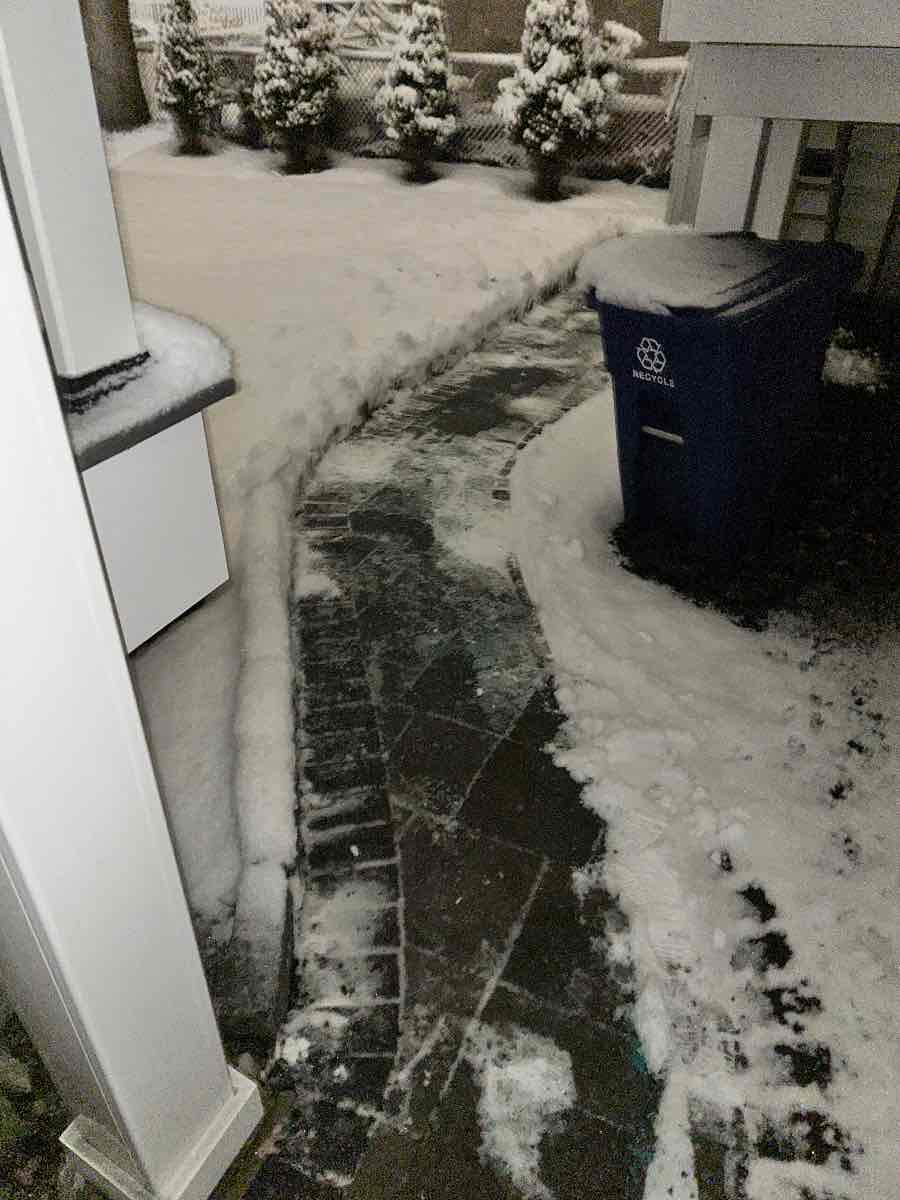
First, a Word on the Rules
Every city and town sets its own snow rules, its own deadline, and its own fines — and they change. Boston is not Cambridge, and Cambridge is not Brookline. What follows is our understanding of Boston’s rules as a company that has worked in them for years, not legal advice, and not a guarantee.
Look up the current rule for your own city or town before the season starts. It is usually one search away on your city’s website, and it is worth five minutes. If you own property in more than one town, check each one — we have customers whose two buildings are on different deadlines.
Roughly What Boston Asks For
As we understand it, in Boston the clock starts when the snow stops falling, not when you get home:
- Residential property: sidewalks cleared within about 6 hours after the snow stops.
- Businesses: about 3 hours.
- When snow stops overnight, the clock generally starts in the morning — but we would not plan around that, because ice that forms overnight is its own hazard regardless of what the deadline says.
We believe the fines run in the range of $50 for smaller residential buildings, $100 for larger ones, and $200 for commercial — per incident, and they repeat storm after storm. Again, confirm the current numbers for your own town.
The part that matters more than the exact hours: it is generally not enough to cut a narrow path. The expectation is the full width of the sidewalk, with nothing left piled on curb cuts, crosswalks, intersections, or handicap ramps — which is exactly where someone gets hurt. Pushing the snow out into the street is its own problem.
And honestly, the fine is the small part. The real exposure is somebody slipping on a sidewalk you were responsible for.
Why 6 Hours Is Harder Than It Sounds
Six hours sounds generous until you notice when Boston storms actually end. They end at 9pm. They end at 1am. They end during Sunday dinner. The clock does not wait for a convenient morning.
That is the part people underestimate. It is not “can I shovel this?” — most people can. It is “will I be awake, home, and physically able to shovel at 4am on a Tuesday, and again the next storm, and again the one after that?” Over a full winter the answer is usually no. And it only takes one miss.
When Snow Actually Gets Cleared in Boston
Here is something we can show you that most companies cannot. Every visit our crews make is documented with a timestamped before photo when they arrive and after photos when they finish. Across six winters that is over 154,000 photos on snow jobs alone.
Looking at 6,343 documented snow visits, here is the hour the crew actually started work at a property:
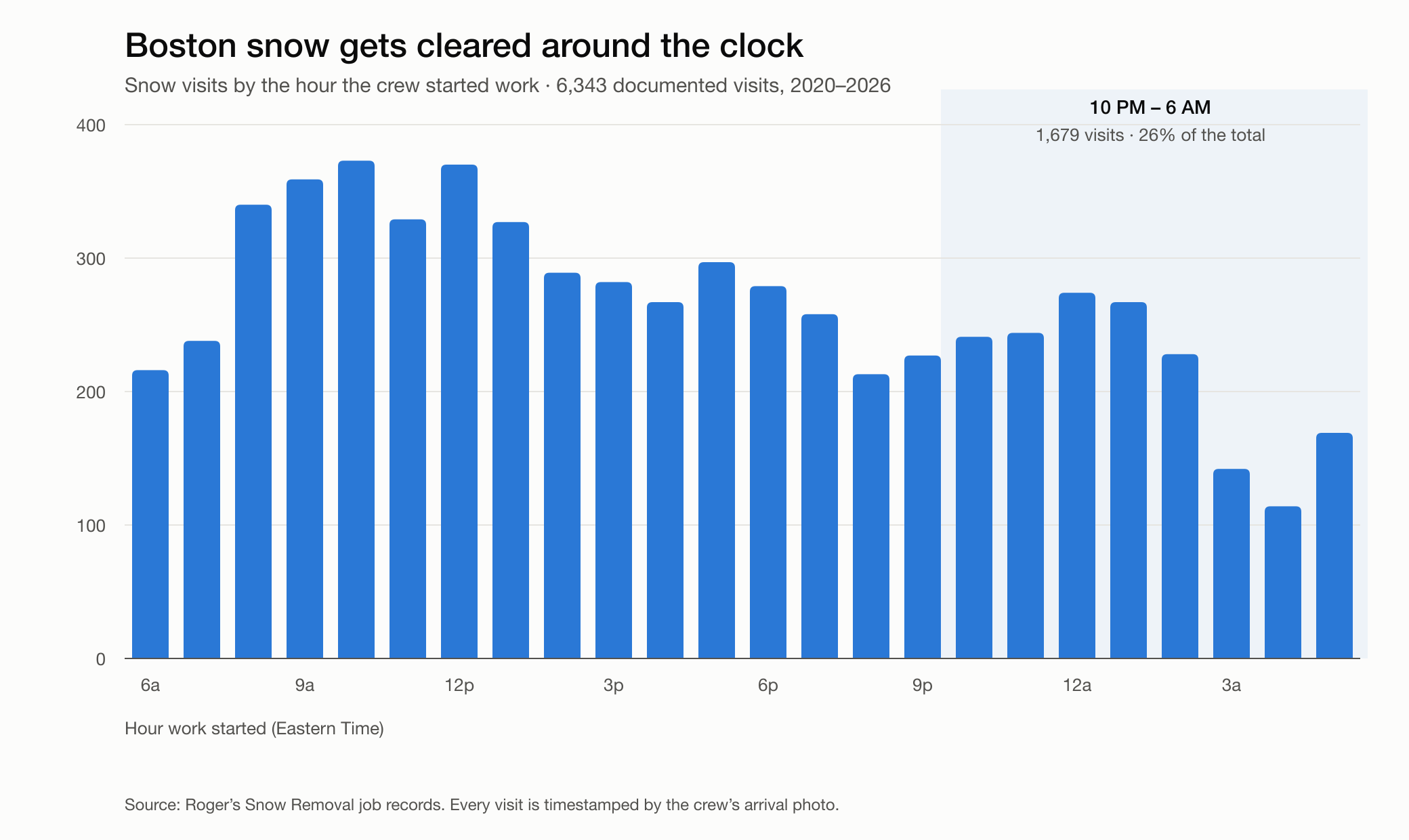
- 26% of properties were started between 10pm and 6am.
- 22% were started before 7am.
- The work runs across all 24 hours. Our busiest stretch is mid-morning, but the overnight hours never go quiet — the 1am bar is taller than the 8pm bar.
That is the whole point. Snow removal is not a business-hours job, and a company that treats it like one will have you clearing your own sidewalk at 5am. When a storm ends at 11pm, the properties that are clear by sunrise are the ones somebody worked on overnight.
How Long Does One Property Actually Take?
If you are weighing doing it yourself against hiring someone, it helps to know the real numbers. Measuring from the arrival photo to the final finished photo, the typical property takes:
- About 20 minutes for a straightforward property — a short walkway, a set of steps, a small sidewalk frontage.
- About 45 minutes for a typical property.
- About 75 minutes for a difficult one — long frontage, a corner lot, multiple entrances, a driveway with a plow ridge across it.
Those are working minutes, in the cold, in the dark, often more than once per storm. Multiply by the number of times it snows and the do-it-yourself math changes.
How Many Times Per Winter Is This, Really?
People plan for the blizzard. The blizzard is not the problem — you remember the blizzard and you deal with it. The problem is the six inches in December, the two inches in January, and the ice in February.
Here is how many separate days we sent crews out, by season:
- 2020–21 through 2023–24: 17 to 18 service days each winter
- 2024–25: 26 service days
- 2025–26: 41 service days — our busiest winter on record, 2,675 visits
Last winter the average property on our route was serviced more than 8 times. Eight separate mornings somebody was out in the dark so our customers did not have to be.
Setting Your Trigger: We Recommend 2 Inches
Every customer sets a trigger — how much snow has to fall before we come out to clear it. Across our route last winter:
- About half of customers set it at 2 inches.
- About 1 in 6 set it at 3 inches.
- About 1 in 5 want us out at any accumulation, no minimum.
- The rest set it at 1 inch.
For most properties we recommend 2 inches, and it is what most of our customers choose. Below about 2 inches, a full shovel-out is usually not what the property needs, and paying for one every time a dusting falls is not a good use of your money.
The obvious question is what covers you below that line — because a sidewalk with an inch of packed snow that froze overnight is still slippery, and no ordinance has a 2-inch trigger.
The answer is that snow clearing is not the only thing we do. On nights when almost nothing falls but the temperature drops, the risk is ice, and ice is handled with salt and de-icer rather than a shovel. That is real work on our calendar, not a footnote: last winter there were 10 separate days when the measured accumulation was zero and our crews still went out to roughly 550 properties. Nothing to shovel. Everything to salt.
So the 2-inch trigger is about when we bring the shovels, not about when we stop paying attention. If your property is unusually exposed — a north-facing walkway that never sees sun, a steep entry, an elderly tenant — tell us, and we will talk about whether a lower trigger or a standing salt arrangement makes more sense for you.
If You Get Fined, We Pay It
If your property is on our route and you get a ticket for snow we were responsible for, we cover it. We think that is the only honest way to sell this service. A company that takes your money to keep your sidewalk clear and then leaves you holding the fine when it isn’t has the incentives backwards.
Ask any company you are considering the same question, and get the answer before you sign.
What to Ask Any Snow Removal Company
Whether you hire us or someone else, these are worth asking:
- Do you work overnight? If they only work daytime, you will miss the window on any storm that ends at night.
- How do I know you came? Ask for timestamped before-and-after photos of every visit. We send them on every job. A company that cannot show you this is asking you to take their word for it.
- What is my trigger, and what happens below it? Get the number in writing, and ask specifically what covers ice.
- Do you salt, and is it included? Ice is what causes falls, and de-icer is expensive and sometimes hard to get mid-season.
- On a big storm, do you come back? On a 6-inch-plus storm a property usually needs 2 to 3 visits, including one during the storm. One pass at the end is not enough.
- Who pays if I get fined? We do. Ask them.
Summary
Around Boston you have a matter of hours after the snow stops before your sidewalk becomes your problem — roughly 6 for a home and 3 for a business, though every town writes its own rule and you should look yours up.
The hard part is not knowing the rule. It is that storms end at night, 41 times last winter, and the clock runs while you are asleep. Across six winters, more than a quarter of the properties we clear are started between 10pm and 6am. That is the job.
Need snow removal this winter?
We clear snow and ice across Boston and the surrounding towns — Cambridge, Somerville, Brookline, Medford, Quincy, Arlington, Watertown, and more. Every visit is documented with before and after photos, we work through the night so your sidewalk is clear before the deadline, and if you get fined for snow we were responsible for, we pay it. Request a free quote on our website or give us a call: